
EUALAN
Salesforce: How a B2B brand created category and community.
What has Salesforce really changed?
From the “No Software” campaign to the Trailblazer community and Agentforce, this analysis separates fact, research, and interpretation to show how a B2B brand transforms technology into a category and where that strategy finds its limits.
Audio Experience
Listen to the complete article in audio, preserving its original structure, pacing, and intent.
How a technical change became a new category
The campaign that removed CRM from the list of features.
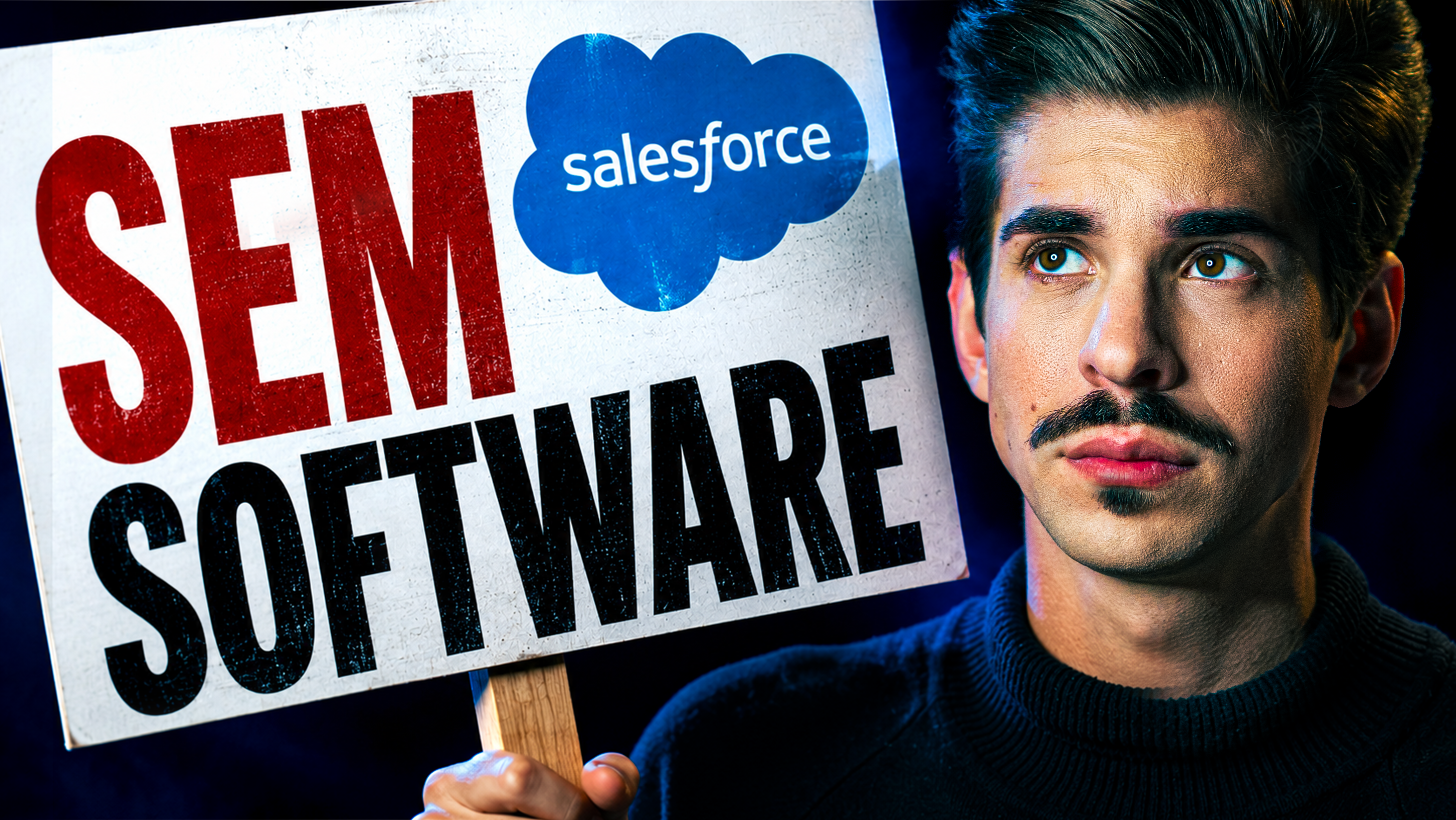
In February 2000, Salesforce officially launched at the Regency Theater in San Francisco. The company's own timeline records 1,500 attendees, a performance by The B-52s, and the theme "The End of Software." The following month, hired actors appeared in front of a Siebel Systems conference simulating a protest against traditional software. The staging garnered attention because it seemed bigger than a product campaign: it heralded the disappearance of an era.
The most important gesture wasn't the provocation itself. It was the refusal to accept the comparison proposed by competitors. If the discussion remained restricted to screens, reports, and lists of functionalities, a startup would have to prove that its CRM was superior item by item. By transforming the choice into "installed software or internet service?", Salesforce sought to shift the judgment to a territory where it represented the future and the incumbents carried the past.
This is a strategic reading, not a fact that corporate chronology alone can prove. The event and the protest are verifiable; the interpretation is that both functioned as category-building tools. The distinction matters because it prevents a good marketing story from being mistaken for automatic evidence of product superiority.
To delve deeper into this connection, see Red Bull's marketing strategy: going beyond the product .
The change wasn't just rhetoric: it was a new usage agreement.
The campaign only gained lasting traction because there was an operational shift behind it. In its 2004 SEC filing, Salesforce described a browser-delivered, subscription-based CRM service operating on a multi-tenant architecture. Instead of each customer purchasing, installing, and maintaining all the local infrastructure, the application was provisioned as a service over the internet.
Today this seems commonplace because software as a service has become part of the business vocabulary. At the turn of the century, however, the proposal altered the distribution of costs and responsibilities. Servers, updates, and some of the operational complexity migrated from the client to the provider. The prospectus itself associated the model with faster deployment, lower initial investment, and simpler access to benefits presented by the company and, therefore, not treated here as universal guarantees.
The strategic substance lay in this contract change: the client wasn't just choosing another CRM; they were choosing a different way to consume technology. “No Software” oversimplified what was happening—software still existed in abundance, but it made visible a transformation that was difficult to explain in a sales presentation. The narrative didn't create the technical change; it gave the change an antagonist, a symbol, and a decision that was easy to understand.
Framing: change the question before selling the answer.
In 1981, Amos Tversky and Daniel Kahneman showed that choices can change when the same problem is formulated in different ways. In experiments reported in Science, equivalent alternatives produced distinct preferences depending on whether they were presented in terms of gains or losses. The framing effect does not mean that people are incapable of deciding; it shows that the formulation of the problem participates in the decision itself.
In the case of Salesforce, the most effective framing wasn't "our CRM has more features." It was "why does your company still buy and maintain software the old way?" The first question favors a comparison spreadsheet. The second transforms the delivery model into a central criterion and allows the brand to define what it means to move forward.
There is a crucial limit. Framing studies have been conducted on specific problems and do not prove that every B2B purchase can be won through language. A strong frame guides attention; it does not eliminate price, risk, integration, security, or performance. If the antagonist is invented, or if the promise is not confirmed by experience, the resource ceases to organize the choice and begins to produce distrust.
To delve deeper into this connection, see Why nobody wants to be alone in making the wrong decision ?
Using a product also begins to say who you are.
Salesforce's second endeavor was less noisy and perhaps more difficult to copy. The first Dreamforce, in 2003, gathered just over a thousand participants. Two decades later, the company describes the Trailblazer Community as a global network of millions of people who learn, exchange help, and meet in groups and events. The language of trails, badges, mascots, and certifications offers participants visible ways to recognize progress and belonging.
Social psychology helps us understand why this can be valuable. The tradition of Henri Tajfel treats group belonging as a relevant part of self-definition and social behavior. This doesn't mean that every Salesforce administrator incorporates the brand into their own identity. It allows us to formulate a more precise hypothesis: when a professional practice offers names, symbols, rituals, and peer recognition, it can become a reference point for how someone describes their career.
Research on brand communities deepens this understanding. Albert Muñiz and Thomas O'Guinn identified shared awareness, rituals and traditions, and a sense of responsibility among members of communities formed around brands. James McAlexander, John Schouten, and Harold Koenig showed that community experience involves a network of relationships: person and product, person and company, person and brand, and people among themselves. Shared events and experiences can strengthen this network.
None of these studies examined Salesforce. The connection is analytical: Dreamforce, Trailhead, and Trailblazer provide an infrastructure where knowledge, professional reputation, and relationships can circulate together. CRM ceases to be just a tool used during work hours and begins to support language, credentials, and connections that continue to exist outside the product screen.
To delve deeper into this connection, see: Is that certification you see? It's probably fake .
Belonging is not a substitute for usefulness.
There's a dangerous temptation in this story: to conclude that community automatically produces loyalty. The evidence is more cautious. A study of 3,305 members of two brand communities on Facebook found relationships between community engagement, community promotion, and dimensions of loyalty. At the same time, simple activity on the platform had little or no relation to brand loyalty.
The result doesn't measure the Trailblazer Community or enterprise CRM contracts, but it helps to separate presence from engagement. The number of members, posts, badges, or participants in an event doesn't, by itself, demonstrate value to the customer. Community becomes active when it solves real problems: it accelerates learning, facilitates peer support, opens up career paths, and improves product usage.
There is also a cost. Certifications, vocabulary, and professional relationships can make a platform change more laborious, but this should not be confused with satisfaction. For a B2B brand, the healthy test is not "how many people are in?", but rather "what can they do better by being here?". Sustainable belonging is a consequence of shared utility, not a cosmetic fix for a weak experience.
The paradox of the disruptor who became the incumbent.
The campaign against traditional software worked because Salesforce could occupy the role of challenger. Success changes that position. When the company comes to represent an important part of the corporate infrastructure it previously challenged, it is no longer enough to declare that the old world is over. The market may demand that the innovation be demonstrated within a large platform, with accumulated clients, integrations, and risks.
Agentforce repeats familiar elements of the strategy. In October 2024, Salesforce announced the general availability of a layer for creating and deploying agents capable of performing actions in business functions. Marc Benioff went on to describe a world where managers coordinate people and digital agents. Once again, the product is presented as a bridge between two eras, now from exclusively human work to collaboration with agents.
The difference is that autonomous agents amplify the cost of an inaccurate promise. Salesforce itself publishes guidelines on guardrails, transparency, and provenance, and in its annual report, acknowledges adoption, privacy, employment, regulatory, and reputational risks related to AI. These records do not invalidate Agentforce; they show that "new era" is an operational hypothesis that needs to be tested, governed, and measured, not just announced.
This is the most fertile strategic conflict in the case. A startup can request permission to experiment. An incumbent sells trust and needs to innovate without treating its installed base as disposable. The brand maintains credibility when the narrative acknowledges this tension and presents evidence of change: tasks completed correctly, clear boundaries, human scaling, security, and verifiable economic results.
1999 — Salesforce is founded.
2000 — Release of “The End of Software” and staged protest.
2003 — The first Dreamforce, with just over a thousand participants.
2024 — General availability of Agentforce.
The advantage doesn't lie in the loudest story.
The Salesforce case doesn't simply teach you how to "create an enemy." It teaches you to look for a real change that the market can't yet name. Initially, the antagonist was a recognizable set of costs and frictions: local infrastructure, complex deployment, and upfront investment. The campaign condensed this tension into a symbol. Without the change in delivery mode, the symbol would have been mere spectacle.
It also doesn't teach you how to build a community. Symbols, events, and certifications only gain substance when they connect people around learning and practice. The brand can facilitate the environment, but it cannot decree belonging. It is the value exchanged between members and between them and the product that transforms an audience into a community.
Ultimately, history shows that positioning accumulates debt. The more a company promises to represent the future, the greater the burden becomes when it itself ages. Renewing the narrative is legitimate; the risk arises when the vocabulary changes faster than the experience. For a B2B brand, the most defensible position combines four elements: genuine friction, concrete change, a useful community, and evidence that survives the initial excitement of the launch.
To delve deeper into this connection, see Familiarity creates preference .
Strong narrative: acknowledged friction, concrete change, observable evidence, and explicit limits.
Inflated narrative: invented enemy, unchanged vocabulary, promise without meter, and objection treated as ignorance.
Quick diagnosis
Open each question and compare the answer to your own business.
Is there real friction that the market recognizes?
Start with a problem the customer already understands without needing your pitch. In Salesforce's case, the installed software carried costs, implementation, and complexity that the market was familiar with. If the pain point only becomes apparent after you explain your solution, it's probably not yet strong enough to support a new category.
What concrete change does your solution introduce?
Describe an operational change, not just a product advantage. Salesforce didn't just introduce a CRM with more features; it proposed a different way to access and consume software. If you can't explain the concrete change in one sentence, the narrative is probably moving faster than the product.
What evidence proves that the narrative is true?
Look for evidence that would still exist even without the slogan: adoption, retention, cost reduction, time savings, customer behavior, or documented results. A strong narrative interprets reality; it doesn't replace evidence.
Is there enough utility to sustain community and belonging?
A community needs to deliver recurring value: learning, recognition, networking, career advancement, peer support, or access that justifies returning. If people only show up to consume content produced by the brand, you've probably built an audience—not a community.
Does experience support the promise?
Compare the narrative with the actual use of the product, support, integration, safety, and results. When the brand vocabulary evolves faster than the delivered experience, there are two healthy options: improve the substance or reduce the promise.
Essential Highlights
Key excerpts from the original content, designed for quick reading without losing context.
How to apply logic without copying the performance.
Use the case as a diagnostic process, not as a license to invent an enemy or launch a grandiose slogan.
Name a verifiable point of friction. Interview customers and identify costs, delays, or risks they already recognize. The antagonist must exist before the campaign.
Define the concrete change. Document what the product or operating model does differently and what evidence demonstrates that difference.
Turn change into a deciding factor. Create a question that helps the customer evaluate alternatives, without hiding price, integration, security, or adoption effort.
Build meaningful engagement. Offer learning opportunities, peer recognition, and pathways for contribution. Measure problems solved and professional growth, not just registrations.
Test the gap between narrative and experience. Compare promise, actual use, support, results, and complaints. If the vocabulary advances faster than the delivery, reduce the promise or improve the substance.
Prepare for the next phase before becoming incumbent. Review which parts of the story remain true, which have become legacy, and which changes can be safely demonstrated.
Track indicators across three layers: product adoption and results; learning, peer support, and community contribution; and trust in the brand promise. Audience growth without improvement in the other two layers is a cause for concern, not a strategic advantage.
Avoid the most common mistake: treating resistance as a communication failure. In complex markets, objections can reveal difficult integration, risk of change, or inflated promises. Before reinforcing the narrative, find out if the problem lies in understanding or delivery.
Key Takeaways
Core ideas that expand and deepen this analysis.
Related Content
These resources explore the strategy, decision-making, and communication principles behind this analysis.

You might also like
Red Bull 's marketing strategy: going beyond the product broadens the discussion by connecting the case to other brand building, category, and market share strategies.
Why does nobody want to be alone in making the wrong decision? This expands the discussion by connecting the case to mechanisms of behavior, belonging, and decision-making. Why does nobody want to be alone in making the wrong decision?
This certification you see? It's probably fake. This expands the discussion by connecting the case to how signs of authority influence trust and judgment. This certification you see? It's probably fake.
Familiarity creates preference, broadening the discussion by connecting the case to mechanisms of behavior, belonging, and decision-making. Familiarity creates preference.
The Three Filters of Decision-Making expands the discussion by connecting the case to mechanisms of behavior, belonging, and decision-making. The Three Filters of Decision-Making
What sets you apart? The Nathalia Beauty case, Schopenhauer, and the mistake that brings down even competent professionals broadens the discussion by connecting the case to mechanisms of behavior, belonging, and decision-making. What sets you apart? The Nathalia Beauty case, Schopenhauer, and the mistake that brings down even competent professionals.
How Duolingo Became Addictive (Full Analysis) expands the discussion by connecting the case to another brand building, category, and market share strategy. How Duolingo Became Addictive (Full Analysis)
Sources and references
The Framing of Decisions and the Psychology of Choice
Individuals and groups in social psychology
Are Facebook brand community members truly loyal to the brand?
All About the Trailblazer Community
Salesforce's Agentforce Is Here: Trusted, Autonomous AI Agents to Scale Your Workforce
Salesforce Fiscal 2025 Annual Report